
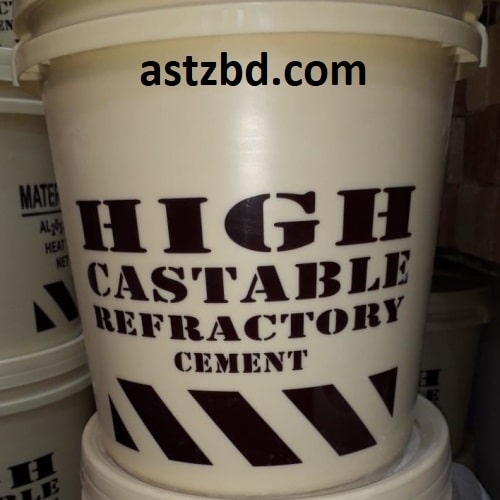
Description
High castable refractory cements (often referred to as high-temperature castable refractories) are specialized heat-resistant materials designed to withstand extreme temperatures, typically up to 3,000°F (1,650°C) or higher, while maintaining structural integrity. These cements are a type of refractory castable—a granular and powdery mixture of refractory aggregates (like high-alumina materials), binders (such as calcium aluminate cement), and additives—that can be mixed with water to form a pourable or trowelable mortar. Once cast or applied, they harden chemically and cure into a solid, brick-like form suitable for lining or repairing high-heat environments.
Key Properties
- Temperature Resistance: Rated for continuous use at 2,000–3,270°F (1,093–1,800°C), depending on the formulation (e.g., 94% alumina content for ultra-high performance).
- Composition: Primarily high-alumina aggregates (Al₂O₃ content often 60–94%) with low-iron, low-cement binders for purity and reduced shrinkage. Low water demand improves density and strength.
- Mechanical Strength: High compressive strength (rock-hard when cured), excellent thermal shock resistance, and low thermal conductivity for better insulation and energy efficiency.
- Chemical Resistance: Withstands erosion from acids, slags, sulfur fuels, and reducing atmospheres; resists carbon deposition and abrasion.
- Appearance and Form: Supplied as a dry, pre-mixed powder (often light brown when cured); sets hydraulically without firing.
Applications
These cements are versatile for industrial and DIY high-heat projects:
- Furnaces and Kilns: Lining for boilers, incinerators, crematoriums, and metallurgical furnaces.
- Fireplaces and Stoves: Repairing fireboxes, casting custom firebrick, or forming solid stove beds.
- Ovens and Forges: Building pizza ovens, forges, or induction furnaces.
- Other Uses: Guniting, troweling, or extruding for floors, walls, or custom shapes in heat-intensive structures.
Mixing and Installation Guidelines
- Preparation: Use clean, potable water (avoid contaminated sources). Mix only what can be used in 20–30 minutes, as it sets quickly. Ratio: Typically 1 quart water per 12.5 lbs dry mix.
- Mixing: Stir dry powder thoroughly, add water gradually, and blend for 3–5 minutes until lump-free but not overly wet (excess water causes shrinkage and weakness).
- Application: Pour or trowel immediately; vibrate to remove air pockets. Dampen surfaces to prevent moisture loss.
- Curing: Allow 24 hours at ≥60°F (16°C) under plastic cover to retain moisture. Gradually heat to expel chemically bound water (steam) before full use.
- Storage: Keep dry; shelf life 6–12 months.
Common Products and Examples
| Product Example | Temperature Rating | Key Features | Source |
|---|---|---|---|
| LOUCAST 3000 | 3,000°F | Low-iron, high-purity; ideal for sulfurous environments | Sheffield Pottery |
| Rutland Castable | 3,000°F | Sets as hard as brick; easy for custom casts | Rutland Products |
| MEECO’s Red Devil | 3,000°F | Versatile dry mix; paintable when cured | MEECO |
| Simond Store 94% Alumina | 3,270°F | Dense, low-cement; superior slag resistance | Simond Store |
| A900 CA70 High Alumina | Varies (up to 3,000°F) | Binder for castables; fast-setting | Oreworld Trade |
Note on “vanai dew”: This term does not appear in standard refractory literature or product descriptions from reliable sources. It may be a misspelling, brand name, or specific variant (e.g., possibly “Vana Dew” or a regional product). If this refers to a particular supplier, location, or code (e.g., from India or a manufacturer like Vanai), provide more details for a refined search. For general high castable refractories, the above covers established options. Always consult safety data sheets for handling, as these materials involve alkaline dust and high heat.


Reviews
There are no reviews yet.