
Description
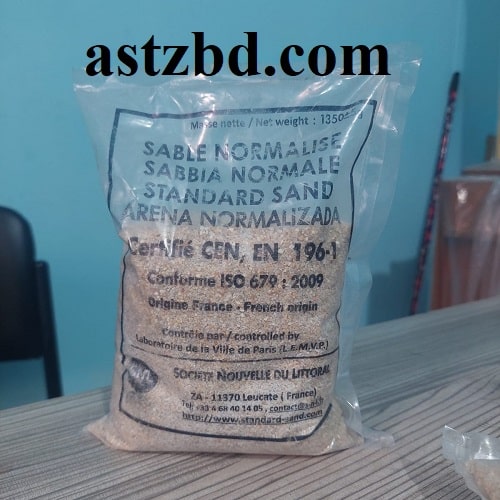
Introduction Standard Sand EN-196-1 for Cement Testing
The Standard Sand EN-196-1 for Cement Testing provides cement testing laboratories, construction material research centers, and quality control departments with the internationally certified reference sand they need to conduct accurate and reproducible cement mortar compressive and flexural strength tests. This CEN (European Committee for Standardization) certified reference sand meets the strict grading, silica content, and moisture requirements of EN 196-1 and ISO 679 standards, ensuring that every mortar prism a laboratory produces delivers test results comparable to those from any other certified laboratory worldwide. Engineers and laboratory technicians across Bangladesh who test ordinary Portland cement, blended cement, and specialty binders depend on this Standard Sand EN-196-1 for Cement Testing to generate the reliable strength data that cement manufacturers, construction companies, and regulatory authorities require for product certification, mix design, and compliance verification.
Specifications Standard Sand EN-196-1 for Cement Testing
| Specification | Details |
| Product Name | CEN Standard Sand / ISO Reference Sand |
| Standard Compliance | EN 196-1, ISO 679 |
| Certification Body | CEN (European Committee for Standardization) |
| Manufacturer / Origin | NORMENSAND GmbH, Germany (official CEN producer) |
| Sand Type | Natural siliceous sand (rounded grain) |
| Silica (SiO₂) Content | ≥ 98% |
| Particle Size Distribution | 0.08 mm – 2.00 mm (controlled grading) |
| Grading Fractions | Three combined fractions per EN 196-1 Table 1 |
| Moisture Content | ≤ 0.2% by mass |
| Package Weight | 1350 g ± 5 g per bag |
| Bags per Mortar Batch | 3 bags (1350g × 3 = 4050g) per standard batch |
| Cement-to-Sand Ratio | 1 : 3 (by mass, per EN 196-1) |
| Water-to-Cement Ratio | 0.50 |
| Packaging Type | Heat-sealed polyethylene bag |
| Shelf Life | Unlimited (when stored dry and sealed) |
| Storage Condition | Store in dry conditions away from moisture |
| Traceability | Batch certificate included with each shipment |
Particle Size Distribution (EN 196-1 Table 1)
| Sieve Size (mm) | Cumulative Passing (%) |
| 2.00 | 99 ± 1 |
| 1.60 | 87 ± 5 |
| 1.00 | 67 ± 5 |
| 0.50 | 40 ± 5 |
| 0.16 | 7 ± 3 |
| 0.08 | 2 ± 1 |
Key Features Standard Sand EN-196-1 for Cement Testing
- Full EN 196-1 and ISO 679 Compliance — This sand meets every physical, chemical, and grading requirement of EN 196-1 and ISO 679, giving laboratories confidence that their mortar strength test results align with international reference values.
- ≥ 98% Silica Purity — The high silica content ensures chemical inertness during mortar mixing, preventing any sand-cement reaction that could distort compressive or flexural strength test results.
- Controlled Three-Fraction Grading — The manufacturer blends three precisely controlled particle size fractions to produce the exact grading curve that EN 196-1 specifies, batch after batch.
- Certified Batch Traceability — Every shipment carries a batch certificate from the manufacturer documenting silica content, moisture content, and particle size distribution test results for full laboratory traceability.
- Low Moisture Content (≤ 0.2%) — The sand arrives at moisture content well within the EN 196-1 limit, eliminating the need for pre-drying and reducing preparation time before mortar mixing.
- Standardized 1350g Package — Each bag contains exactly 1350g ± 5g, matching the single-batch quantity that EN 196-1 prescribes for one cement-to-sand mixing cycle, reducing weighing errors in the laboratory.
- Rounded Natural Grain Shape — The naturally rounded grain shape produces consistent mortar workability and compaction behavior, contributing to reproducible prism density and strength results.
- Durable Heat-Sealed Packaging — The polyethylene bag heat seal protects the sand from moisture absorption and contamination during shipping and storage, preserving grading integrity until use.
Applications
- Cement compressive strength testing — preparing standard 40mm × 40mm × 160mm mortar prisms for 2-day, 7-day, and 28-day compressive strength determination per EN 196-1
- Cement flexural strength testing — producing standard prisms for three-point bending flexural strength tests that EN 196-1 requires before compressive testing
- Cement manufacturer quality control — verifying consistency of cement production batches against certified strength class requirements (42.5N, 52.5R, etc.)
- Third-party cement certification testing — providing independent strength test data for cement product certification under BNBC, EN 197-1, and ISO 9001 quality system requirements
- University and polytechnic research — conducting cement hydration, supplementary cementitious material (SCM), and admixture research using a standardized reference sand matrix
- Construction material research institutes — evaluating fly ash, GGBS, silica fume, and other pozzolanic material performance using EN 196-1 mortar as the reference system
- Government testing laboratories — generating certified cement strength test data for market surveillance, import clearance, and product approval by BSTI and other regulatory authorities
- Admixture and concrete chemical product testing — assessing mortar workability, setting time, and strength development of chemical admixtures using a standardized mortar system
Who Uses This
- Cement manufacturing company QC laboratories at facilities operated by Crown Cement, Shah Cement, Meghna Cement, Premier Cement, and other Bangladesh producers
- Civil engineering university departments at BUET, KUET, RUET, CUET, and private universities conducting cement and concrete materials research
- BSTI (Bangladesh Standards and Testing Institution) laboratories conducting official cement product certification and market surveillance testing
- Independent third-party testing laboratories serving construction companies, developers, and importers requiring certified cement strength reports
- Concrete admixture and chemical companies evaluating product performance on standardized mortar systems before market introduction
- Construction project quality control teams on major infrastructure projects requiring certified cement compliance documentation
- Research scholars working on cement replacement materials, green concrete, and low-carbon binder systems at Bangladeshi universities
- Import clearance testing laboratories verifying imported cement compliance with BSTI and EN 197-1 standards before customs release
Frequently Asked Questions (FAQ)
Q1. Why must we use EN 196-1 standard sand instead of locally sourced river sand or Sylhet sand?
EN 196-1 specifies standard sand because natural local sands vary widely in grading, silica content, grain shape, and moisture. These variations change mortar workability and compaction, producing strength results that no other laboratory can reproduce or compare. Standard sand eliminates all those variables so every laboratory produces the same mortar matrix and generates internationally comparable strength data.
Q2. How many bags of standard sand does one EN 196-1 mortar batch require?
One standard mortar batch per EN 196-1 requires 1350 g of cement and 1350 g × 3 = 4050 g of standard sand at a 1:3 cement-to-sand ratio. Therefore, each batch consumes exactly three 1350 g bags. One batch produces three 40 mm × 40 mm × 160 mm prisms, yielding six compressive strength specimens after flexural testing.
Q3. Does this sand require drying before use?
No. The manufacturer supplies CEN standard sand at moisture content ≤ 0.2%, which falls within the EN 196-1 acceptance limit. Laboratories can use the sand directly from the sealed bag without pre-drying, saving preparation time. However, always check that the bag seal remains intact before use.
Q4. How do we verify the authenticity of standard sand we receive?
Every genuine batch of CEN standard sand from NORMENSAND GmbH carries a batch certificate documenting the particle size distribution, silica content, and moisture content test results. astzbd supplies this certificate with every shipment. Laboratories should check the batch number on the certificate against the bag label to confirm authenticity.
Why Buy From astzbd
- Certified Authentic CEN Standard Sand — astzbd supplies genuine NORMENSAND GmbH CEN standard sand with full batch certification, giving laboratories complete traceability and regulatory confidence.
- Batch Certificate with Every Order — astzbd includes the manufacturer’s batch test certificate documenting particle size distribution, silica content, and moisture content with every shipment.
- Reliable Stock Availability — astzbd maintains consistent stock of EN 196-1 standard sand to support cement factory QC schedules, research programs, and institutional testing calendars without supply gaps.
- Nationwide Delivery Across Bangladesh — astzbd delivers to cement factories, universities, testing laboratories, and research institutions across all 64 districts of Bangladesh through a dependable courier and freight network.
- Bulk Order Supply Capability — astzbd fulfills large recurring orders for cement manufacturers and major testing institutions at competitive pricing with reliable delivery scheduling.
- Expert Technical Guidance — The astzbd team provides pre-sales guidance on EN 196-1 test setup, sand usage quantities, and accessory equipment needs so laboratories configure their testing correctly from the start.
- Secure Moisture-Protected Packaging — astzbd ships standard sand bags in outer protective packaging that shields the heat-sealed bags from moisture and physical damage during transit.
- Trusted by Bangladesh’s Cement and Construction Testing Community — Cement manufacturers, university laboratories, BSTI-accredited testing facilities, and research institutes across Bangladesh rely on astzbd as their standard testing material supplier.
SNL Graded Standard Sand ASTM C778 France – Premium Testing Sand for Cement & Mortar Analysis


Reviews
There are no reviews yet.