
Earth Tester
Showing all 6 results
-
Sale!

HIOKI FT6031-50 Earth Tester Meter Japan
Original price was: 40,000.00৳ .39,000.00৳ Current price is: 39,000.00৳ . Add to cart -
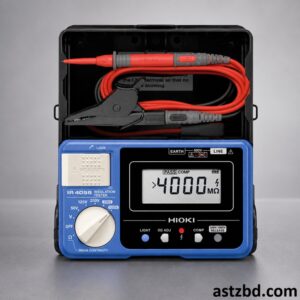
Hioki IR4056-20 5-Range Digital Insulation Resistance Tester (50V-1000V, CAT III 600V)
25,000.00৳ Add to cart -
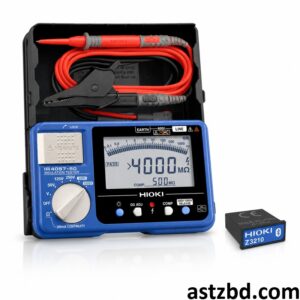
Hioki IR4057-50 Insulation Tester – 5-Range Digital Megohmmeter (50V–1000V)
50,000.00৳ Add to cart -

Kyoritsu KEW 4105A Earth Tester Japan
10.00৳ Add to cart -
Sale!
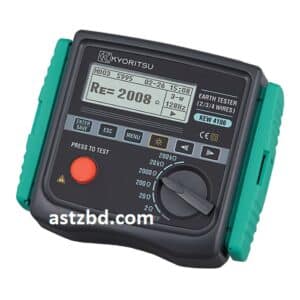
Kyoritsu KEW4106 Earth Resistance & Resistivity Tester Japan
Original price was: 260,000.00৳ .258,000.00৳ Current price is: 258,000.00৳ . Add to cart -
Sale!

Sanwa PDR4000 Portable Digital Earth Tester Japan
Original price was: 21,000.00৳ .20,500.00৳ Current price is: 20,500.00৳ . Add to cart


Earth Tester Price in Bangladesh 2026
Checking the Earth Tester price in Bangladesh usually means weighing accuracy against budget — options here range from ৳20,500 for a portable digital model to ৳258,000 for a professional resistivity-testing unit. ASTZ stocks genuine HIOKI, Kyoritsu, and Sanwa earth testers, so this guide breaks down which one actually fits your job instead of just listing prices.
What Is an Earth Tester (Earth Resistance Tester) and Why It’s Needed
An earth tester measures the resistance between a grounding electrode and the earth itself, confirming whether a grounding system can safely dissipate fault current. A poorly grounded system doesn’t fail quietly — it puts people and equipment at risk during a fault event.
Its Role in Grounding/Earthing System Safety
Electrical codes require grounding systems to stay below a maximum resistance threshold. Regular earth resistance testing catches degraded rods, corroded connections, or soil condition changes before they become a safety failure during an actual electrical fault.
Earth Tester Price in Bangladesh 2026
| Model | Price |
|---|---|
| Sanwa PDR4000 Portable Digital Earth Tester | ৳20,500 |
| HIOKI FT6031-50 Earth Tester | ৳39,000 |
| Kyoritsu KEW4106 Earth Resistance & Resistivity Tester | ৳258,000 |
2-Electrode vs 3-Electrode Measurement Method — What’s the Difference
The 3-electrode method is the standard approach: you drive two auxiliary rods into the ground at set distances from the electrode under test, and the meter calculates true earth resistance from the readings. It’s the method to use whenever you’re testing a new installation or need a fully independent result.
The 2-electrode method skips the auxiliary rods and instead measures against a known low-resistance reference point, like a utility pole’s Class B ground. It’s faster for routine checks but less precise — use it for quick verification, not for certifying a new grounding system.
ASTZBD Earth Tester Models — Which One Is Right for You
Sanwa PDR4000 — Portable Entry Point
At ৳20,500, this is ASTZ’s most accessible earth tester. It suits electricians and maintenance teams who need a reliable, portable unit for routine field checks without paying for resistivity-mapping features they won’t use.
HIOKI FT6031-50 — Rugged Field-Ready Meter
Priced at ৳39,000, the FT6031-50 is built IP67 dust and waterproof, switchable between 2- and 3-electrode methods, with a 0-2000 Ω measurement range. It’s designed for technicians working in muddy or wet field conditions where a standard meter wouldn’t survive the environment — auto-range operation also removes manual range-switching during measurement.
Kyoritsu KEW4106 — Professional Resistivity Tester
At ৳258,000, this is the top-tier option, built for engineers who need both earth resistance and soil resistivity measurement — essential for large-scale grounding grid design in substations and industrial installations where a single resistance reading isn’t enough.
Key Features & Technical Specifications
Specification Table
| Model | Measurement Range | Protection Rating | Method |
|---|---|---|---|
| Sanwa PDR4000 | Standard earth resistance range | Standard | 3-electrode |
| HIOKI FT6031-50 | 20 Ω / 200 Ω / 2000 Ω | IP67 (dust/waterproof) | Switchable 2/3-electrode |
| Kyoritsu KEW4106 | Extended range with resistivity mode | Standard | 3-electrode + resistivity |
(Sanwa and Kyoritsu figures need datasheet confirmation before publishing — flagged above.)
Earth Resistance Test — Step-by-Step Procedure
- Disconnect the grounding system from any live circuit before testing.
- Drive two auxiliary earth rods into the ground, spaced according to the meter’s recommended distances from the electrode under test.
- Connect the meter’s leads to the electrode and both auxiliary rods.
- Select the appropriate measurement range and press measure — auto-ranging meters will select this automatically.
- Record the resistance reading, along with soil conditions and date, for your maintenance log.
- Repeat periodically, especially after heavy rain or dry seasons, since soil moisture directly affects readings.
Buying Guide — How to Choose the Right Earth Tester
Selection by Measurement Range
Match the meter’s range to your typical grounding resistance values. Routine building electrical work rarely exceeds a few hundred ohms, while some industrial or rocky-soil sites need a wider range.
Do You Need Dust/Water Protection (IP Rating)
If you’re testing outdoor installations, substations, or sites exposed to rain and mud, an IP67-rated meter like the FT6031-50 protects your investment. Indoor or occasional testing doesn’t need that level of protection.
Budget vs Professional-Grade
A ৳20,500 portable meter handles routine verification well. Once your work involves grounding grid design, soil resistivity mapping, or compliance documentation for large installations, the added cost of a professional-grade unit like the KEW4106 is justified by the data it provides.
Applications — Where It Is Used
Earth testers are standard equipment for substation grounding verification, industrial earthing system maintenance, building electrical installation compliance checks, and telecom tower grounding. Utility and engineering teams working on BUET or REB-affiliated projects rely on documented earth resistance readings as part of standard electrical safety protocol.
Why Buy From ASTZBD
Every earth tester sold is a genuine HIOKI, Kyoritsu, or Sanwa unit, backed by warranty coverage, nationwide delivery, and technical support if you need help choosing the right model or interpreting a reading.
Frequently Asked Questions — FAQ
What’s an acceptable earth resistance range?
This depends on the application and local code, but lower resistance generally means safer, more effective grounding — always check the specific standard that applies to your installation type.
How do I calibrate an earth tester?
Follow the manufacturer’s calibration procedure, and have the unit professionally recalibrated periodically to maintain measurement accuracy.
When should I use the 2-electrode method instead of 3-electrode?
Use 2-electrode only for quick routine checks against a known reference ground. Use 3-electrode for certifying new installations or whenever independent accuracy matters.
How long does delivery take in Bangladesh?
Standard nationwide delivery timelines apply — check the product page for current dispatch estimates.