
Aggregate Testing Equipment
Showing all 8 results
-
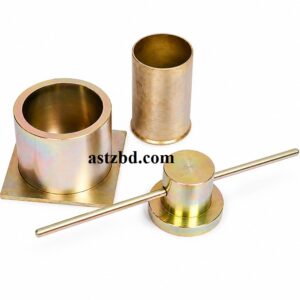
Aggregate Crushing Value Tester – ACV Test Apparatus for Coarse Aggregate Strength Testing
15,000.00৳ Add to cart -
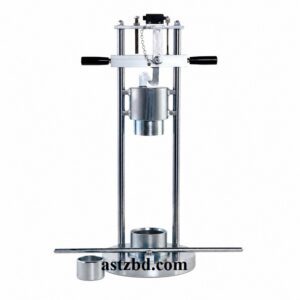
Aggregate Impact Value Testing Machine – AIV Test Apparatus for Coarse Aggregate Toughness Evaluation
30,000.00৳ Add to cart -
Sale!
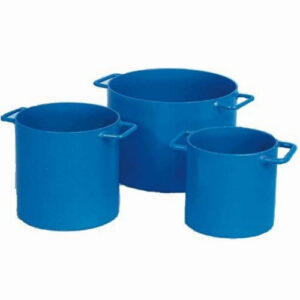
Bulk Density measures Cylinder 5L, 10L, 15L,
Original price was: 10,000.00৳ .9,200.00৳ Current price is: 9,200.00৳ . Add to cart -

Concrete Density Test Unit Weight Measure Set
45,000.00৳ Add to cart -
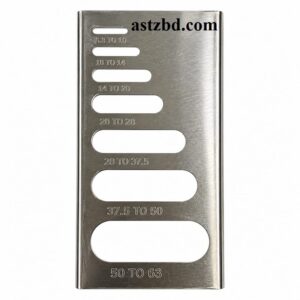
Flakiness Gauge Bangladesh — BS 812-105.1 Thickness Gauge for Aggregate Flakiness Index Testing | ASTZBD
3,200.00৳ Add to cart -
Sale!
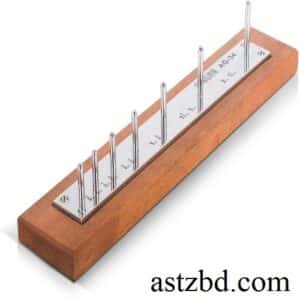
Length gauge for aggregate in Bangladesh
Original price was: 4,200.00৳ .4,000.00৳ Current price is: 4,000.00৳ . Add to cart -
Sale!
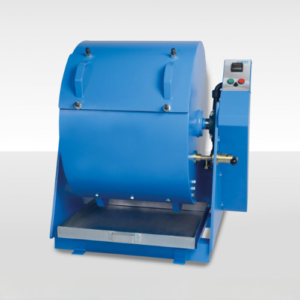
Los Angeles Abrasion Machine in Bangladesh
Original price was: 70,000.00৳ .64,000.00৳ Current price is: 64,000.00৳ . Add to cart -
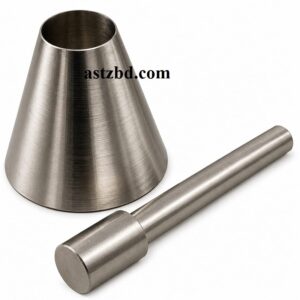
Sand Absorption Cone & Tamper Rod – Fine Aggregate Specific Gravity and Water Absorption Test Apparatus
4,000.00৳ Add to cart

Aggregate Testing Equipment Price in Bangladesh 2026 — AIV, ACV, Flakiness Gauge & More
Every road, bridge, and high-rise building in Bangladesh rests on aggregates — crushed stone, gravel, and sand that form the structural backbone of concrete and pavement. But without testing, there is no way to know whether those aggregates are actually strong enough to carry the loads placed on them. That’s why Aggregate Testing Equipment price in Bangladesh is a critical search for civil engineers, lab managers, and construction QC teams before every project procurement. At ASTZ BD, we supply a complete range of genuine aggregate testing apparatus — from AIV machines and ACV sets to flakiness gauges and specific gravity kits — each meeting the standards accepted by BUET, LGED, RHD, and international bodies.
Best Aggregate Testing Equipment Price List 2026 in Bangladesh
| Equipment | Test Type | Standard | Price (BDT) |
|---|---|---|---|
| Aggregate Crushing Value (ACV) Apparatus | Compressive strength of coarse aggregate | IS 2386 Part IV, BS 812 | 15,000 |
| Aggregate Impact Value (AIV) Testing Machine | Impact toughness of coarse aggregate | IS 2386 Part IV, BS 812-112 | 30,000 |
| Flakiness Gauge (Thickness Gauge) | Flakiness index of coarse aggregate | BS 812-105.1 | 3,200 |
| Length Gauge (Elongation Gauge) | Elongation index of coarse aggregate | BS 812-105.2 | 4,000 |
| Sand Absorption Cone & Tamper Rod | Specific gravity & water absorption of fine aggregate | ASTM C128, BS 812 | 4,000 |
Prices are subject to stock availability. Contact ASTZ BD directly to confirm current pricing before ordering.
What is Aggregate Testing and Why Is It Critical for Bangladesh’s Construction Industry?
Aggregate — the collective term for sand, gravel, and crushed stone — makes up 60–80% of any concrete mix. Its strength, shape, size distribution, and water absorption directly determine how a finished structure performs under load, weather, and time. Skipping aggregate testing doesn’t save money. It moves the cost downstream — into structural failures, RHD rejection of road layers, or worse, post-construction collapse.
Bangladesh spends hundreds of billions of taka annually on infrastructure. Every kilometre of national highway, every bridge deck, every flyover in Dhaka, and every high-rise concrete frame depends on aggregate quality decisions made early in the supply chain. Testing is what turns that decision from a guess into a verified fact.
What Happens When Aggregate Quality Goes Untested?
The consequences of poor aggregate reach beyond failed lab reports. When crushed stone with high impact value (weak aggregate) goes into a road surface layer, it breaks down under vehicle loads within months — not years. Roads constructed with flaky or elongated aggregates develop surface cracking and rutting prematurely because those particles fracture easily under compaction.
In concrete structures, aggregates with excessive water absorption weaken the cement-aggregate bond, reduce compressive strength, and increase shrinkage cracking over time. Bangladesh has seen several high-profile infrastructure quality failures attributed directly to unverified aggregate supply. Testing equipment is the first line of defence against these outcomes.
Which Bangladesh Standards Apply? (BNBC, BUET, LGED, RHD Requirements)
Bangladesh’s construction and infrastructure sector operates under several overlapping standards:
BNBC (Bangladesh National Building Code) references IS and ASTM standards for aggregate quality in structural concrete, specifying limits for crushing value, water absorption, and gradation.
LGED and RHD follow IS 2386 and BS 812 series for road aggregate testing, with specific acceptance limits for AIV, ACV, and flakiness index depending on the pavement layer — wearing course, base course, or sub-base.
BUET, KUET, RUET, and other engineering universities conduct aggregate testing for research and materials qualification following both IS and BS standards.
Any aggregate testing equipment procured for use on government-funded projects or submitted as part of a materials approval package must demonstrate compliance with these codes. ASTZ BD supplies equipment that meets IS 2386 Part IV, BS 812, and ASTM standards — accepted across all major project types in Bangladesh.
Types of Aggregate Testing Equipment — What Each Test Actually Measures
Aggregate Impact Value (AIV) Machine — Toughness Testing
The AIV machine measures how well coarse aggregate resists sudden shock — the kind of impact that occurs under roller compaction and moving traffic. The machine drops a calibrated 13.5–14.0 kg hammer 15 times from 380 mm height onto a confined aggregate sample. The percentage of fines produced is the Aggregate Impact Value.
For RHD road wearing courses, AIV must not exceed 30%. For base course layers, the limit is 35%. An aggregate that fails this test will physically break down under traffic loading, no matter how well the rest of the pavement is designed. At ASTZ BD, the AIV Testing Machine is priced at 30,000 BDT and fully complies with IS 2386 Part IV and BS 812-112.
Aggregate Crushing Value (ACV) Apparatus — Strength Testing
Where the AIV test applies sudden impact, the ACV test applies a slow, increasing compressive load — simulating the gradual stress aggregates experience in concrete and sub-base layers. The ACV apparatus uses a steel cylinder, plunger, and tamping rod to confine the aggregate sample, which is then loaded in a compression testing machine.
For concrete wearing surfaces, ACV should not exceed 30%. For general concrete work, the limit is 45%. The ACV Apparatus at ASTZ BD is priced at 15,000 BDT — a cost-effective entry point for labs setting up aggregate QC capability from scratch.
Sieve Shaker & Test Sieves — Gradation & Particle Size
Gradation testing determines the particle size distribution of an aggregate sample — whether it contains the correct proportions of coarse, medium, and fine particles for its intended use. An incorrectly graded aggregate produces a concrete mix with poor workability, higher void content, and weaker bond strength.
A sieve shaker automates the vibration process across a stacked set of test sieves, producing consistent and reproducible gradation results far more reliably than manual hand-sieving. ASTZ BD stocks both electric sieve shakers and standard IS/ASTM test sieve sets for aggregate gradation work.
Flakiness & Elongation Index Gauge — Shape Testing
Aggregate shape directly affects how particles pack together under compaction. Flaky particles (thin relative to their size) and elongated particles (long relative to their width) create unstable packing arrangements with higher void content — leading to poor compaction, reduced pavement strength, and increased binder demand in bituminous mixes.
The Flakiness Gauge (Thickness Gauge) — priced at 3,200 BDT at ASTZ BD — uses seven labeled slots per BS 812-105.1 to classify aggregate particles as flaky or non-flaky. The Length Gauge (Elongation Gauge) at 4,000 BDT evaluates elongation per BS 812-105.2. Both are mandatory tests for aggregate approval on RHD highway projects.
Specific Gravity & Water Absorption Apparatus — Density & Porosity Testing
Specific gravity and water absorption are fundamental aggregate properties used in concrete mix design calculations, asphalt mix proportioning, and quality acceptance testing. The Sand Absorption Cone & Tamper Rod at 4,000 BDT is specifically designed for fine aggregate (sand) specific gravity testing per ASTM C128 and BS 812.
High water absorption in aggregates means more water is absorbed into the aggregate particles and lost from the mix — reducing the effective water-cement ratio, weakening workability, and ultimately reducing 28-day compressive strength if not accounted for in mix design. Knowing your aggregate’s water absorption before batching is a basic QC step that pays back in mix consistency.
What to Know Before Buying Aggregate Testing Equipment in Bangladesh
Lab Setup vs Single Equipment Purchase — What Makes More Sense?
For a construction company or contractor setting up an in-house QC lab for the first time, the question is usually where to start. The practical answer is AIV + ACV + gradation — these three tests cover the most commonly required material approval checks for LGED, RHD, and BNBC-governed projects.
If budget allows, adding the flakiness and elongation gauges rounds out the shape testing requirement. Specific gravity and water absorption apparatus are lower cost additions that pay off immediately in concrete mix design accuracy.
For an existing lab looking to expand, ASTZ BD can advise on which equipment gaps are most likely to be flagged in project quality audits based on current client feedback.
Which Standards Must Your Equipment Meet? (IS, BS, ASTM — What’s Accepted in Bangladesh?)
Bangladesh’s civil engineering sector primarily references IS 2386 (Indian Standard) for aggregate testing procedures, which are closely aligned with the original BS 812 series. ASTM standards are referenced in some international joint-venture projects and research contexts.
For LGED and RHD project submissions, IS 2386 compliance is typically the baseline requirement. For BUET and university lab work, either IS or BS equipment is accepted. All ASTZ BD aggregate testing equipment meets the relevant IS and BS standards, with compliance documentation available on request for project material approval packages.
New Equipment vs Locally Fabricated — Quality and Calibration Risks
Bangladesh has a significant market in locally fabricated aggregate testing apparatus — particularly AIV and ACV sets sold at lower prices than imported or quality-manufactured equipment. The risk with locally fabricated equipment is dimensional accuracy and material specification.
The AIV test requires a hammer of precisely 13.5–14.0 kg and a free-fall height of exactly 380 ± 5 mm. A hammer that’s off by even 0.5 kg or a guide column that allows lateral movement introduces systematic error into every test result. Submitting AIV or ACV results from improperly calibrated equipment for government project approval carries real compliance risk.
ASTZ BD supplies equipment manufactured to documented dimensional specifications and provides calibration support, ensuring your test results stand up to third-party verification.
Who Uses Aggregate Testing Equipment in Bangladesh?
Civil Engineering Laboratories (BUET, KUET, RUET, CUET, DUET)
Engineering universities across Bangladesh run aggregate testing as a core component of civil engineering laboratory courses and thesis research. Labs at BUET’s Department of Civil Engineering, KUET, RUET, CUET, and DUET require equipment that delivers reproducible, standards-compliant results for student practicals and faculty research.
ASTZ BD supplies engineering institutions with full aggregate testing sets that meet course requirements under IS 2386, and provides technical documentation to support laboratory setup and equipment procurement approval processes.
Road & Infrastructure Contractors (LGED, RHD, Bridge Division Projects)
Contractors working on LGED rural road projects, RHD national highway works, and Bridge Division structures are required to submit aggregate quality test reports as part of material approval before commencing earthworks or pavement layers. In-house testing capability reduces dependence on third-party labs, speeds up approval timelines, and gives QC teams real-time data to reject substandard aggregate at the stockpile before it reaches the mix plant.
The AIV and ACV machines are the most commonly required by RHD material approval officers. Flakiness and elongation gauges become mandatory for wearing course aggregate qualification on Class I and II highways.
Ready-Mix Concrete Plants & Quarry Operators
Ready-mix concrete plants need consistent aggregate gradation and water absorption data for every new aggregate delivery to maintain mix design integrity. A batch plant that mixes without checking incoming aggregate against the approved mix design is essentially producing concrete of unknown strength.
Quarry operators supplying aggregate to major construction projects increasingly need in-house testing capability to provide certified quality documentation with each delivery — a market requirement that is growing as project specifications tighten in Bangladesh’s infrastructure sector.
Private Material Testing & QC Labs
Bangladesh’s private materials testing sector — third-party labs serving developers, contractors, and government project monitors — requires a complete set of aggregate testing equipment to offer full service to clients. ASTZ BD supplies complete lab setups to private testing companies, including AIV, ACV, sieve sets, specific gravity apparatus, and shape gauges, with technical support for initial calibration and staff training.
Frequently Asked Questions — Aggregate Testing Equipment Bangladesh
What is the price range of aggregate testing equipment in Bangladesh?
At ASTZ BD, aggregate testing equipment ranges from 3,200 BDT for a Flakiness Gauge to 30,000 BDT for a full AIV Testing Machine. A basic three-equipment setup covering AIV, ACV, and shape testing can be assembled for under 55,000 BDT.
Which aggregate test is most commonly required for RHD and LGED projects in Bangladesh?
The Aggregate Impact Value (AIV) test is the most frequently requested for road project material approvals. Aggregate Crushing Value (ACV) and Flakiness Index tests are also routinely required for wearing course and base course aggregate qualification.
Does aggregate testing equipment from ASTZ BD comply with IS 2386 and BS 812 standards?
Yes. All aggregate testing equipment supplied by ASTZ BD meets IS 2386 Part IV and the relevant BS 812 series standards, which are the primary references accepted by LGED, RHD, BUET, and other institutions in Bangladesh.
What is the difference between AIV and ACV tests?
The AIV (Aggregate Impact Value) test measures resistance to sudden impact loading — relevant for road surfaces under traffic. The ACV (Aggregate Crushing Value) test measures resistance to gradual compressive load — relevant for structural concrete and sub-base layers. Both tests are often required together for complete aggregate qualification.
Can I use flakiness and elongation gauges for all aggregate sizes?
Flakiness and elongation index tests apply only to aggregates larger than 6.3 mm. The Flakiness Gauge at ASTZ BD covers BS 812-105.1 specifications with seven labeled thickness slots for different size fractions. The Length Gauge covers BS 812-105.2 for elongation assessment.
Does ASTZ BD provide after-sales support for aggregate testing equipment?
Yes. ASTZ BD provides technical support for equipment setup, calibration guidance, and spare parts sourcing. All equipment comes with manufacturer warranty and local service support across Bangladesh.